
Play Dirty
A near perfect reversal

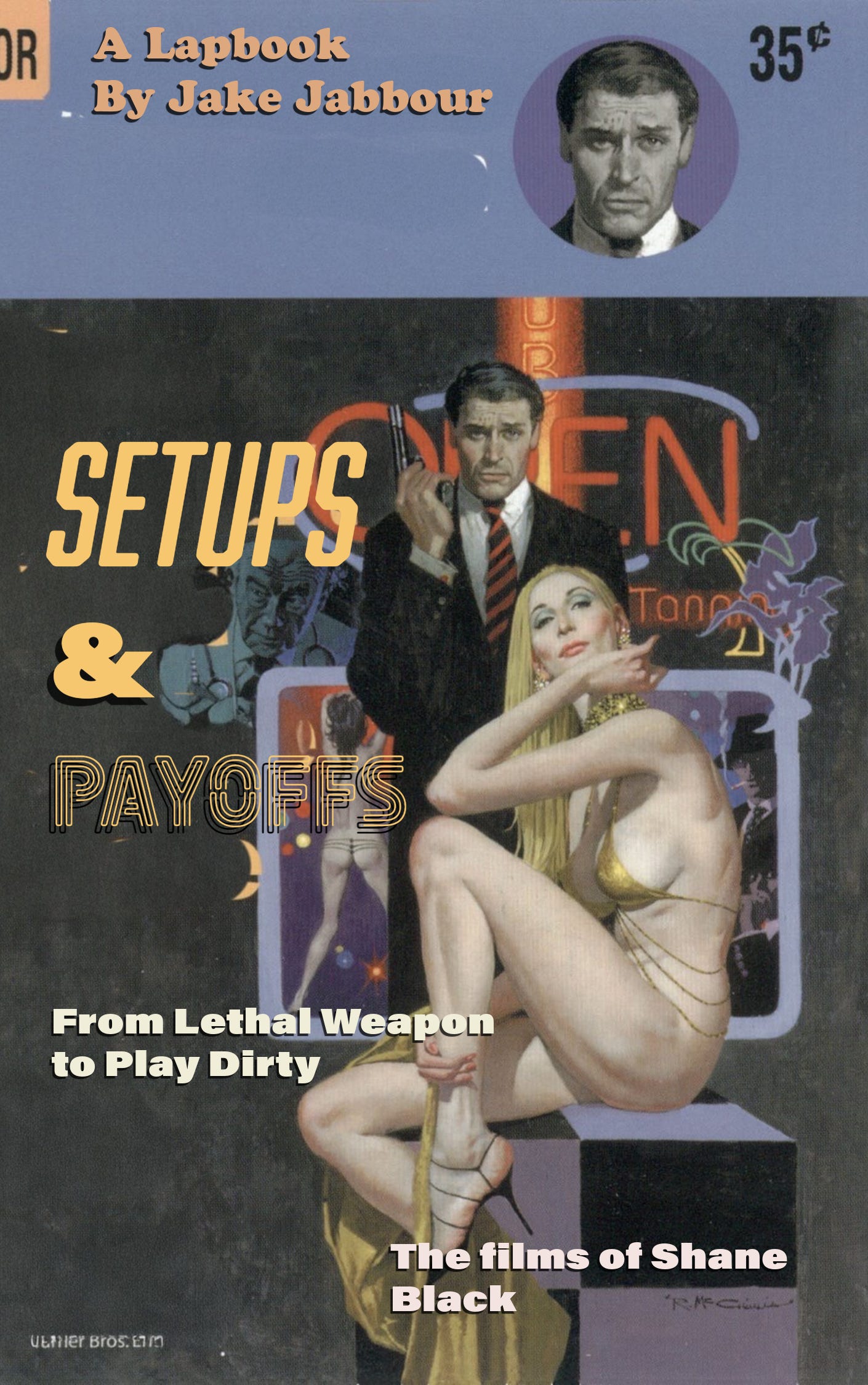
I’ve been a little quiet on here because I’m working on a book about the films of Shane Black. Here is the rough draft I wrote just after seeing Play Dirty. I suspect it will change somewhat, but I wanted to share what I’ve been working on. It’s got mild suggestive spoilers, but nothing dramatic. I’d still encourage you to watch the movie before reading.
The only other thing you need to know is that this is the last chapter so there might be some references to other works. And each chapter concludes with some signature Black categories. I’ve left the definitions in and so I hope it’s not too disorienting. Thanks for reading!
My friend Gilli said it best as we were leaving a preview screening of Play Dirty followed by a Q&A with Shane Black, Jules Daly and Susan Downey. She said something like “it didn’t really feel like Parker needed his crew.” She’s right. Parker, played by Mark Wahlberg, who could do a role like this in his sleep, seemed perfectly self-sufficient. Now I’m not saying he could have pulled off the capers and the bloodshed on his own. It just didn’t seem like he needed anyone to prop him up. That’s an interesting development for a character in a movie written by a man who became the architect of so many flawed guys doing good. It’s a surprising and telling reversal for Shane Black.
In many ways, Play Dirty is Black’s most distinct movie yet. Yes it bears all his signatures. It’s got crackling, witty dialogue, ruthless villains, comedic characters propelling the plot, guns, tits, explosions, henchmen, torture, and of course a masterful execution of setups, payoffs, and reversals. During Christmas of course. And then there are the zags. From its whisper release with no theatrical run, to it being set in New York, to the absence of a dead woman at the center of the mystery, to the protagonist’s high body count, Play Dirty is Black’s agreeable contradiction. It’s his loudest meditation and gentlest bloodbath.
At the center of these contradictions are three distinctions that intrigue me the most. There is Parker’s self-love, the absent buddy dynamic, and the budding of a “crew” element in Black’s trajectory. Looking at what has changed and what has remained the same presents a satisfying payoff in Black’s thirty year career.
One thing I’ve noted repeatedly about Shane Black movies is that as Black got older and more experienced, his heroes became less actively violent. The movies never missed a beat down, but his leads became less professional killers and more accidental death merchants. Harry Lockhart magically bodied half a dozen bad guys through instinctual self-defense. Jackson Healey reforms by the end of the movie. However in Play Dirty, Parker is icing everyone. With malice. With intent.
Parker is self-assured. He has a will to live. Compare this with Riggs or Hallenbeck or Marsh or Heeley or Stark or Harry or even Slater. All those characters wrestled with purposeless despondency and dread. The exceptions being Samantha Caine or Charley Baltimore, and Quinn McKenna. In those cases, Samantha Caine was the afterlife for Charly. She had already been killed, wiped off the map. The movie was about her exploration into who she was that led to her demise and the radical acceptance of both her past and present self. It was posthumous self-improvement. McKenna in The Predator is actually most like Parker. They are both highly trained tactical men who lose their crews to a single killer, and then spend the rest of the movie in revenge mode, enlisting comrades along the way.
The buddy element falls away. Yes Parker is very close with Grofield (LaKeith Stanfield), and McKenna becomes very close to Nebraska, but these are friendships that never really go deeper than a “friend from work.” They trade stories and yell at each other, but they never trade blows, eat dinner at the other ones’ house, or kiss each other on the mouth to avoid suspicion. They keep everything professional, even if the profession is killing.
In Lethal Weapon, Riggs gets strung up and tortured by a torture enthusiast who uses a wet sponge and a car battery. It looks excruciating. In Play Dirty, Parker gets stripped down to his underwear, handcuffed to a pipe and has water thrown on him. Black is taking it easier on himself. Don’t get me wrong, it’s still torture, but it’s a little softer especially when you consider the heightening torture in TV and movies has taken. Anyone seen Task? Fuckin’ hell. In Lethal Weapon, Riggs frees himself and goes on a one-man neck-snapping rampage. In Play Dirty, Parker gets released by his captor and then saved by his frenemy. Our hero is no longer working alone. He’s in communication. He’s collaborating. He’s not as tortured and he’s not as alone.
I’ve listened to countless interviews with him and he always touches on how he suffers from imposter syndrome. He wrote brilliant scripts that fetched high paychecks and with nearly every one except Lethal Weapon, the movie bombed, or was critically shredded. Every time he was up, the town kicked him in the dick. Sometime after The Long Kiss Goodnight but before Kiss Kiss Bang Bang, Black applied to The Academy. He was turned down and told to reapply when he had more credits. Even Iron Man 3, a success both critically and at the box office faced all this ridiculous backlash over how it portrayed The Mandarin. The Nice Guys is a masterpiece no one saw. The Predator is a disaster that everyone saw. It’s no wonder he’s haunted by imposter syndrome. The perception is he is overrated, yet he is often under seen. Another contradiction. It’s the price one pays for dealing in reversals. Play Dirty is the payoff of a lifetime of setups.
Black’s last four produced scripts were co-written. Additionally he’s directed his last five features. He has developed a self-assuredness and a proficiency that gives him the confidence to love himself and lift up others. His scripts reflect that. His heroes no longer need the love of someone else to persevere. They have the confidence themselves. What they need are collaborators. Smart, talented people to help realize the vision. Black himself went from lethal unbalanced lone gunman Riggs to lethal balanced team leader Parker. Along the way he fumbled as drunks, outcasts, washed up magicians, deluded stars and sulking bruisers. While I don’t think Parker is Black’s best work, I do think it is the work I would wish for him to make. It’s a fun movie written and directed by a guy who no longer feels like God hates him and so he hates him back. It’s got the pulp sensibilities of The Nice Guys and the flashy set pieces of Iron Man 3. It’s a mid budget action movie that holds no punches. The men are less damaged, the women are more dimensional, and the play is dirtier.
In any of those podcasts where Black is interviewed, you will hear forty year old men gush over Shane Black. He was the voice for a bunch of horny boys who spent more time reading books and watching movies than playing outside with friends. His movies were and still are a magnet for anyone, but usually men, who craved adventure but struggled to make friends, which was either the cause or the effect of insecurity. I will always prefer The Nice Guys or Kiss Kiss Bang Bang to Play Dirty. My guess is his fans will feel the same. The internet has been swirling with rumors and requests for a sequel to The Nice Guys. I would love that very much. But if I’m honest, my hope is Shane Black doesn’t have another buddy comedy about broken men in him. And I hope that whatever he does next resonates with me as deeply as his earlier movies. It would be a sign that the real Nice Guys were inside us all along and stuff. I know. Don’t say “and stuff.” Just say “the nice guys were inside me.”
Where you were on the night of…?
A reflection on my earliest memories of watching the movie. No score given.
I was at the Culver City Theater with my friend Gilli for a preview screening the day before Play Dirty released the next day on Amazon Prime. I wore my The Nice Guys t-shirt from Super Yaki, a local movie obsessed t-shirt company. I was extremely hyped and left very satisfied.
The movie preceded a Q&A with Shane Black, and producers Jules Daly and Susan Downey. Before the movie started, Gilli and I were talking about how these types of events are what make living in Los Angeles so great. Even now, with movies being filmed in more tax-rebate friendly states and countries, Los Angeles is still a city populated by movie lovers. I love seeing bus ads and billboards advertising new movies. I remember the first time I visited Los Angeles and seeing a billboard for Once Upon A Time in Mexico. In Colorado, I might have been the only person I knew tracking that movie’s release. In Los Angeles, it was part of the daily commute. I love movie theater lobbies decorated with costumes and props from popular films and the weird gimmicks used for advertising. I once did a scavenger hunt in the Hard Rock Cafe for John Wick: Chapter 4 that involved puzzles and interactions with cos-playing assassins.
After the Q&A, there were movie fans looking to get their posters signed and I even witnessed a guy give Jules Daly a comic book he made. Hollywood attracts artists and it attracts fans. Special screenings bring out both. Seeing these super fans who found their way to the same barely promoted screening I’m at makes me keenly aware of how obsessive I am about my interests and how there will always be someone more fanatical than me. It fills me with this feeling of community and self-consciousness. To everyone who couldn’t be bothered to scour the internet for exclusive events for niche filmmakers, I am a nerd. To everyone who showed up, I am pedestrian. I suppose this is even true for the Swifties of the world. We are all the biggest fan and the most basic participant. It just depends on the venue.
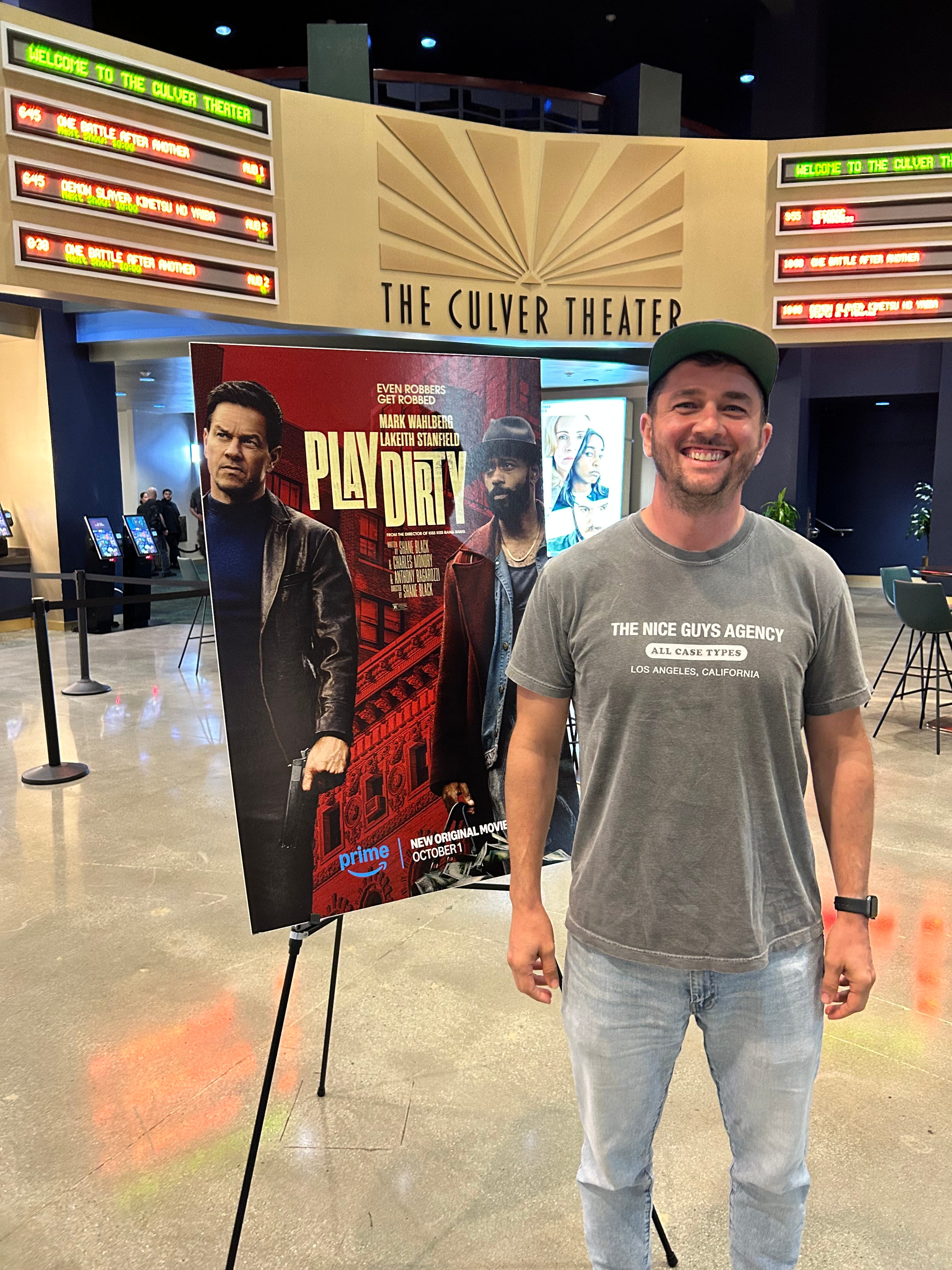
L dot A dot Californi-A
How much of a California movie is this? Rated 0 to 5 Hollwood Stars.
This is not a California movie. It would be hard to read into this, but let’s try anyways. There’s a line in Kiss Kiss Bang Bang where Harry Lockhart is talking about the damaged women in Los Angeles. He says “What is it out here with these women…these are damaged goods…from way back…it’s literally like someone took America by the East Coast and shook it, and all the normal girls managed to hang on.” It’s a misogynistic line and it’s followed by everyone in the club raising their hand to affirm they hate Harry. I suspect it’s how Black felt at one time about the population of Los Angeles. I also suspect he also felt everyone hated him, thus the unanimous vote. Since this new movie takes place in New York and focuses on more proficient thieves and killers, it would appear Black may still relate to parts of that sentiment. He moved his characters to a city where self-image is more positive. The generous read is that since the main heroes and villains are impressive men and women, Black has broadened his view to suggest everyone in Los Angeles is damaged, so to tell a story about self-assured professionals, he had to leave the City of Angels. The less generous read is he’s grown tired of L.A. because he hasn’t matured at all. 0 out of 5 Hollywood stars.
Cheap Trick
There’s a line in Iron Man 3 that references cheap tricks and that being the name of Tony Stark’s autobiography. This category examines the most “Shane Black” scene in a movie.
For Play Dirty, I think this would have to be the robbing of the robbers into the Horse Race scene. It sets up the entire mantra of the movie, gives us a spectacular chase, and shows off our heroes cold blood and mercy.
Next One’s Coming Faster
There is a scene in “Harlan Roulette,” the third episode of the third season of Justified, where Timothy Olyphant’s Marshall Raylan Givens is so pissed off that he storms into Jere Burns’ Wynn Duffy’s Winnebago and knocks him to the ground. Then he takes out his gun, ejects a bullet from the chamber and drops it on Wynn Duffy’s chest. He says “next one’s coming faster.” It is easily the coolest line ever said by anyone in anything. Shane Black knows how to make dialogue sound cool. This is the award for the coolest line in the movie. It’s scored out of five Elmore Leonards (in remembrance of one of our greatest dialogue writers).
I knew the answer to this from the trailer. Black is the king of reversals and so in a movie like Play Dirty where the good guy is good at what he does, a signature reversal is one in which the cool guy looks cool, but actually makes a mistake, and then capitalizes on the mistake. In the construction site scene, Parker shoots a guy, then learns that that guy was the key to the next stage of the heist and that Zen needed him alive. The guy reanimates and fires, shooting Zen in the ear. Parker shoots him again. Zen says “Asshole! You killed him again?”
Parker responds, “Last time, I promise.”
Men of a Certain Age
Black’s writing attracts masculinity. What does his writing say about men? And how has it changed? The rating for this is Ray Romano (0-1) to Scott Bakula (2-3) to Andre Braugher (4-5) (inspired by the TV show that starred them)
Shane Black wrote his first action hero, Martin Riggs as a suicidal widow and a one man killing machine. That is a sexy flaw. Black would never write a hero that fetching again. It’s the reason the premiere action screenwriter never really teamed up with the premiere action stars of the time. Stallone, Douglas, Segal, Snipes. In their prime, these men liked to play rugged heroes against all odds: Cobra, Escape from New York/L.A., Under Siege, Passenger 57. Black’s movies masquerade well as standard masculinity fare, they’re certainly brimming with testosterone, but parfait that shit, and you’ll find it’s rarely a celebration. Black’s scripts examine men at their lowest, and the actors who play them, and what stage of their career they are in, is often a reflection of this. As well as Black’s own station.
This has mostly been examined above already, but I’ll say this. I was reading a lot of reviews on Letterbox about this film and the negative ones really got under my skin. They all basically circled around this idea that Black had lost his flare, that the movie was brainless, that Parker was miscast, and/or that they wanted The Nice Guys 2 instead. These reviews bummed me out because I identify so strongly with my interests that I sometimes feel attacked when something I like is criticized. This is examined more in depth other places in the book, but since this is being posted as a single, I’ll just quickly say that it has been brought to my attention that men conflate interests with personality. From Chuck Klosterman to Nick Hornsby, the popular stance is that we men are what we like. So when something we like is shit on, we feel shit on. This is a deeply illogical application of the transitive property, but it doesn’t make the practice any less prevalent. So I feel attacked, but I also feel discouraged that so many of the reviews are self-reports on arrested development. These men who grew up on Shane Black movies about highly skilled broken men finding purpose and love through trauma are still desperately in need of that affirmation. True this is a streaming movie with a medium talent lead, but it’s also a movie about a confident guy collaborating with others; a reflection of where Black seems to be based on the interviews he’s given. On The Writer’s Panel with with Ben Blacker recorded Sept. 30, 2025 to promote the movie, Black talks about directing and writing and says ”…you need people to love you until you can love yourself. Or to believe in you, until, inexplicably and against all odds, you choose to believe in yourself.” I think that is what this movie is. Black believing in himself.
I’m reminded of a Nipsey Hussle interview where he says “you can be at peace with yourself and at war with the world, or at war with yourself and at peace with the world.” I think Black’s movies have for the longest time been about war with one’s self. This one is about being at war with the world. Both in the sense that this is a more violent film than his previous ones and with regards to his critics. The villains in this movie are big outfits; organized crime, corrupt governments, and billionaires. The establishment. The violence is directed outward not inward. Which ironically, and somewhat sadly, seems to have upset some of his fans. They are still seeking out the company of self-loathing fuck-ups who save the day. For now, that doesn’t seem to be the story Black is interested in telling and that makes me happy. I give this an Andre Braugher+.
Male Friendship
Black examines male friendship and the vulnerability that comes with aging men putting themselves out there. Men are bad at making friends and expressing their feelings. This is the Tim Robinson vehicle, Friendship category. It’s rated out of 5 Tim Robinsons.
Parker avenges his fallen friend on behalf of his friend’s widow. He seems chummy with Grofield, but there isn’t much vulnerability on display here. So I give this 2 out of 5 Tim Robinsons.
Christmas, Kids and Henchmen
If Shane Black scripts were recipes, Christmas, Kids and Henchmen would be the signature ingredients. All three ingredients are rated accordingly. Zero to five Christmas trees, zero to five sassy kiddos, and zero to five henchmen.
Christmas? Yes! I give it three Christmas trees because without the lone man looking in through the window of happier families, the Christmas magic doesn’t hit as hard.
No real kids either. We get the ones playing basketball on the court, and the kid stealing the candy bar, but no sass to speak of. 0/5 sassy kids.
The best henchmen scene in this has to be the runner involving Kincaid. Normally Black’s best henchmen scenes involve a couple of guys capturing or confronting our heroes. They have some silly banter like the Ike, Mike and Mustard guys from Kiss Kiss Bang Bang, or the vocabulary goons from The Last Boy Scout, but in Play Dirty, its one cockroach who won’t die. We’re introduced to him vaping and blowing vapor all over her a girl he passes as he tries to hit on her. He then gets tossed off a building and when Parker and Grofield go to get information out of him, he has a panic attack that they’re going to throw him off another building and he passes out. Very fun stuff to show the consequences of running around with bad guys. Let’s say 3.5 out of 5 henchmen.
The Mystery Machine
What’s the story? What’s the twist? Do I understand it? Does it matter? Zero to Five Scooby Snacks.
Normally Black movies are mysteries, heroes trying to solve something. And normally these mysteries are very hard to follow because ultimately they don’t matter. Black’s stories are just vessels for character growth. Since the characters in Play Dirty don’t really grow there is no mystery to solve. There’s a heist. Heists have a single mystery. How is the crew going to pull it off? The fundamental difference here is with a traditional “who done it,” the reveal is in the end. We know the end of the heist, it’s the theft, so the mystery is in the “how they gon do it?” Because heists are more straight forward they are more difficult to make surprising. Ocean’s Eleven is probably the gold standard. Ocean’s Twelve and Thirteen show the difficulty in making the reveal repeatedly satisfying. The theme of Play Dirty is robbers robbing robbers, so the actual pay off is how many times Black can set this up and make this happen. By my count, it’s an impressive six times. The twists are there, and they land well enough. It’s easy to follow, but perhaps not as fun as a murder mystery being solved accidentally or poorly by lovable dimwits. Since there is so much focus on the heist, the real test of Black’s mystery machine will be in its rewatchability. If the ride rests on the heist’s shoulders and not the characters’, how many times will I re-up? For now, I’m giving it a crunchy 3 out of 5 Scooby Snacks.
And then let’s give this a couple extra points for a truly jaw-dropping cameo scene in the restaurant. I laughed long and loud at the execution.